Stories

From Camera to Viewer

My career has never fit neatly into one box.

With more than 16 years in TV, mostly at A+E Global Media, I moved through very different parts of the business and picked up something that's hard to get from one seat... a feel for how each piece actually works, and how rarely they move as one.

I've seen how technology gets built, how operations hold together, how products reach customers, and how commercial relationships shape the decisions around all of it.

Over time, I found myself drawn to the spaces between those functions. The problems no single department owned. The ones that meant understanding the whole problem, connecting people and systems that each saw a different piece, and taking enough accountability to help get it done.

This isn't unique to television. Businesses across many industries have similar disconnects. Teams that can't see each other's piece. Handoffs where things fall apart. A whole that adds up to less than its parts.

That's the problem I understand, wherever it shows up.

A critical transition needed one person to own the whole outcome.

The Problem

A critical content-distribution workflow had to move off a long-established technology platform, on an aggressive timeline.

This was never just a technology swap. The change reached across internal systems, operations, engineering, business teams and external distribution partners. Everyone owned a piece. No one owned whether the whole thing landed.

That's where projects like this usually stall.

What I Did

I took ownership of that gap.

I mapped the dependencies, coordinated internal teams and outside partners, translated between the engineers building it and the business depending on it, and cleared problems as they surfaced.

Knowing where we needed to go was the easy part. The job was taking accountability for getting us there.

What Changed

A complicated transition spanning multiple internal teams and external partners was completed in roughly four months.

Takeaway

The solution isn't enough. Someone has to own the distance between the solution and the outcome.

A global product had to move, and an organization spread across countries had to move with it.

The Problem

An established media product needed to be repositioned and relaunched, fast.

The strategy was the smaller challenge. Programming, marketing, distribution, operations, technology and leadership all depended on each other, while the people responsible for them sat in different countries with different priorities and views of the same goal.

A plan that looked clean on a slide had to survive contact with all of that.

What I Did

I turned the strategy into something the organization could actually execute.

That meant connecting commercial goals to operational reality, aligning teams in the U.S. and abroad, accounting for what different markets needed, and keeping people who rarely worked together moving toward one launch.

No single lever made it work. Making the pieces work together did.

What Changed

The relaunch went from strategy to market in about three and a half months, delivering a stronger product that achieved year-over-year viewership growth.

Takeaway

Strategy isn't finished when everyone agrees with the presentation. It's finished when the organization can actually run it.

I was living a problem, and it turned out a thousand strangers were too.

The Problem

MOREPHO didn't start with a market analysis. It started with me owning a home.

Ideas were in one place, photos in another, contractor conversations somewhere else, estimates buried in email and decisions scattered across text messages.

Nothing connected. I kept thinking there had to be a better way to hold it all together.

What I Did

I didn't have a traditional software background. I had the problem, and I understood it.

So I designed and built the product around the homeowner's actual experience: organizing projects, capturing ideas and photos, turning a rough idea into a project brief, and keeping the conversation with professionals in one place.

I owned the concept, product strategy, user experience, priorities and execution through launch and iteration.

What Changed

MOREPHO became a real product and drew more than 1,000 registered users organically with no marketing or advertising of any kind. People found it on their own, mostly by searching for a solution to the exact problem I'd been trying to solve.

That number mattered less as traction than as proof. The problem was never just mine. More than a thousand people I'd never met, in homes all over, had quietly been living with the same mess.

And talking with contractors on the other side of those projects led me to another problem entirely, which brings us to the next story.

Takeaway

The clearest sign a problem is worth solving is that people you've never met have already learned to live with it.

MOREPHO Home Project Planner

Visit MOREPHO.com
Download MOREPHO on the App StoreGet MOREPHO on Google Play

A contractor didn't need bigger software. He needed a fix built to his size.

The Problem

A home-improvement contractor was excellent at the work and at his customer relationships. The back office was where things got harder.

Customer details, project scopes, proposals, negotiated pricing, invoices, change orders and payments all needed to stay connected, but almost all of it depended on repetitive manual work.

He didn't need another complicated system to manage. He needed less standing between him and the actual work.

What I Did

I started with the whole lifecycle, not a single document.

I mapped the process from the first customer conversation through proposal, negotiation, acceptance, invoicing and payment. Then I built a lightweight operating layer around the tools he already used, connecting the information and automating the repetitive parts.

That included an AI step that turns his plain description of a job into a structured starting point.

The aim wasn't more software. It was making the software mostly disappear.

What Changed

A request for a better proposal process became an end-to-end back-office workflow.

Information is captured once and carries through. He spends less time rebuilding documents and chasing details, while customers get a more consistent and professional experience.

Takeaway

The right solution is the one that fits. Real change removes work. It doesn't hand you one more system to manage.

What if the problem in television isn't too little, but too much?

The Problem

The industry has gotten extraordinarily good at giving people more. More content. More services. More recommendations. More ways to monetize attention.

But the experience doesn't necessarily feel better.

Discovery is still frustrating. The experience has become fragmented. And some assumptions about how people want to watch have gone unquestioned for so long that they've simply become the way things are done.

What I Did

I started with the question instead of a product.

I studied the behavior, challenged some of those assumptions and started designing a different approach from the ground up.

It's the kind of problem that doesn't sit in any one discipline. Consumer experience, product, technology, content, distribution and economics all touch it, which is what drew me in.

Then, instead of leaving it as an idea, I started building it.

What Changed

That part is still being written.

Takeaway

Sometimes the breakthrough isn't more. It's questioning the thing everyone else stopped questioning.

If you're curious where this idea is headed, I'd be glad to talk. Reach out anytime at john@jvandall.com.

The thread running through all of it

These problems don't look alike. A platform migration, a contractor's invoices, and the future of how we watch television have very little in common on the surface.

Underneath, they're the same kind of problem. Someone is living with something that isn't working and either doesn't have the expertise, the time, or the alternative to fix it. Sometimes they've lived with it so long they've stopped noticing it's a problem.

That's the work I like doing.

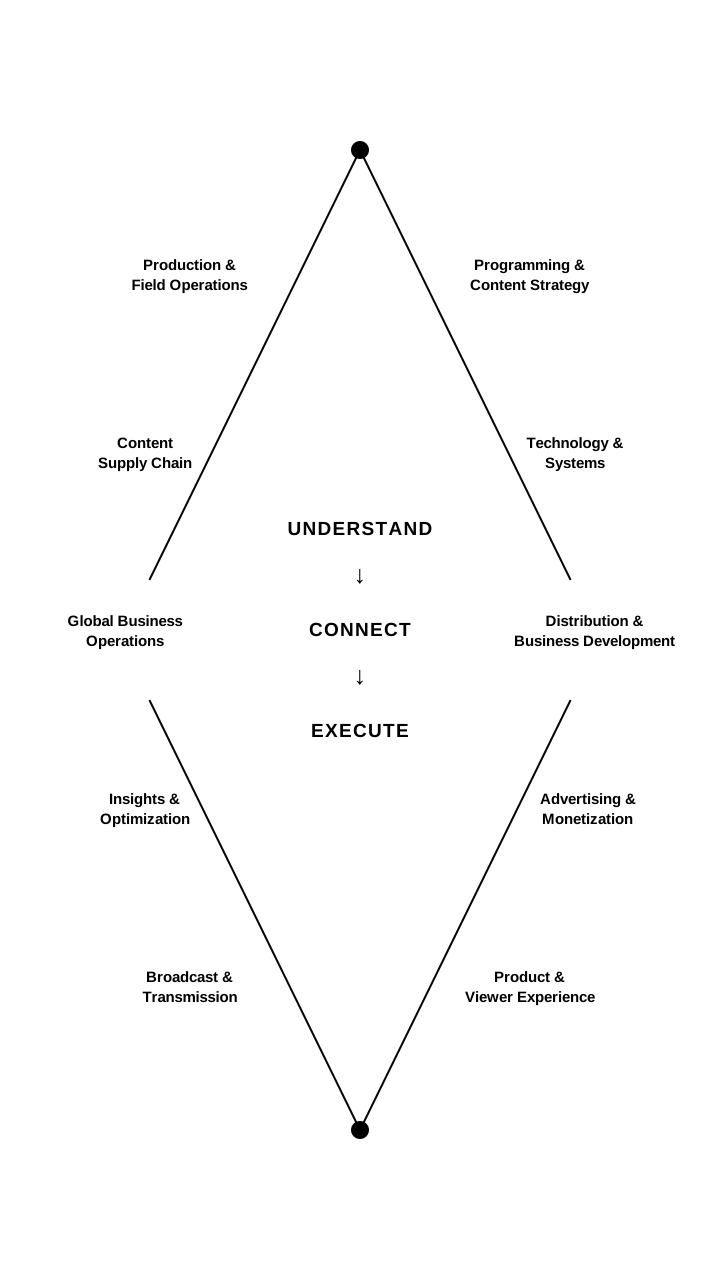
Find the thing people have learned to live with. Understand what's really happening. Connect the people and systems that each hold a piece of it. Then build the fix that actually fits.

Because there's almost always a better way.

Seen enough?

Bring a problem of your own to Think with John AI, or reach out directly at john@jvandall.com.